Honey in the Vedic world
The word madhu appears across the Rigveda (c. 1500–1200 BCE) and later Vedic literature, where it means both "honey" and "sweetness" — a term so central it came to describe mead, sweetness, and metaphorically, delight itself. Bees are described as producers of this sacred substance, and honey was offered in rituals and consumed as a prized food.
In the Ayurveda tradition that followed, honey (Madhu) was classified in detail. Charaka and Sushruta Samhitas describe different honeys by source and quality, and prescribe honey as a carrier for medicines, a wound dressing, and a balancing food. This is the foundation of the "Madhu" you'll still see discussed in Indian wellness contexts today — covered in more depth on our Health & Ayurveda page.

Traditional honey-hunting
Long before modern hives, honey in India came from the wild — and much of it still does. Two traditions stand out for their daring and skill:
- Cliff honey-hunting: In Himalayan regions, collectors descend sheer cliff faces on rope-and-bamboo ladders to harvest the giant combs of the rock bee Apis dorsata. The technique echoes the famous Gurung tradition of Nepal and is still practised in parts of the Indian Himalayas, often with smoke to calm the bees.
- Mouli collectors of the Sundarbans: In the tidal mangrove forests of West Bengal, "Mouli" honey collectors take boats into the delta to find the combs of rock bees hanging from mangrove branches. It is dangerous work — the terrain is treacherous, the tide unpredictable, and the forest is tiger country. Their honey, often called Mouban, is now a celebrated regional specialty with GI protection (see GI & Regional Specialties).

From wild harvest to modern apiculture
Modern, scientific beekeeping in India began in the late 19th and early 20th centuries. Early efforts focused on the native hive bee Apis cerana indica, which was moved from log and wall hives into movable-frame hives. The All India Beekeepers' Association and state departments promoted training and improved equipment from the 1930s onward.
A major turning point came with the introduction of the European honey bee Apis mellifera in the 1960s, initially in the north and later across the country. Its higher yields and gentler temperament made it the workhorse of commercial apiculture — though it also brought challenges, including competition with native bees and new disease pressures. Today India's beekeeping is a mix: native cerana colonies in many regions, mellifera in commercial apiaries, and wild dorsata and florea still harvested traditionally. The full cast is compared on our Bees of India page.
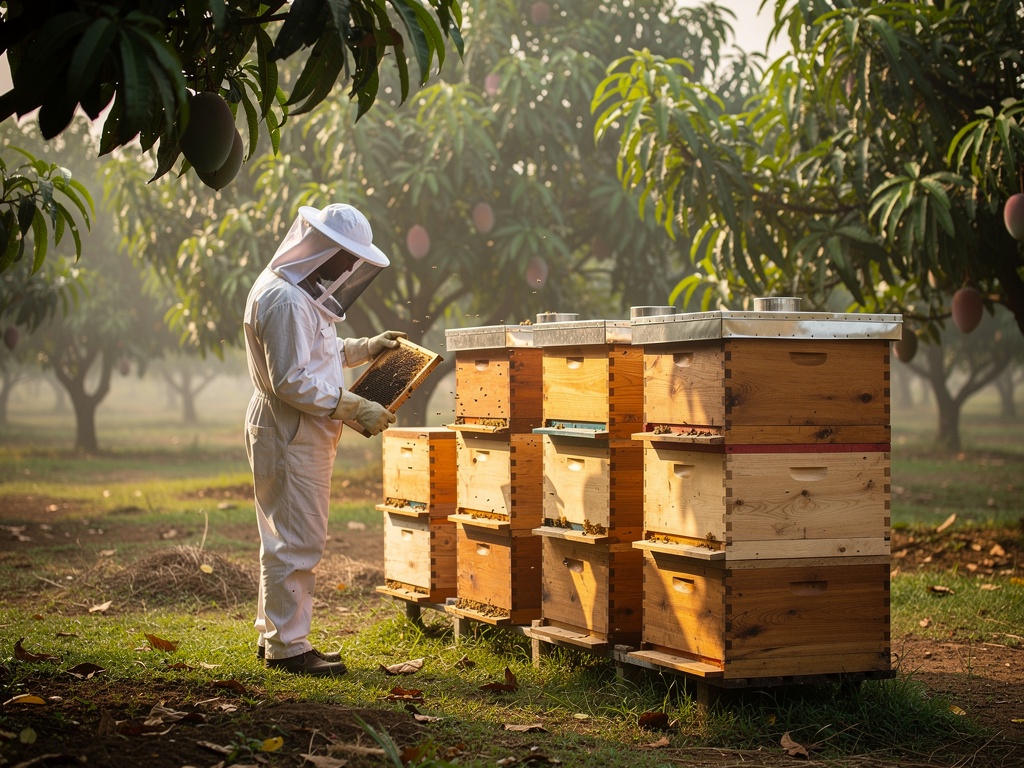
The Sweet Revolution
In 2020, the Government of India launched the National Beekeeping & Honey Mission (NBHM) under the Ministry of Agriculture and Farmers' Welfare, as part of the Atma Nirbhar Bharat package. The mission's goals are broad and explicitly social:
- Promote scientific beekeeping and modern, hygienic honey extraction.
- Support rural livelihoods, especially for small and marginal farmers, women's groups and tribal communities.
- Improve quality and standards so Indian honey competes in global markets.
- Expand pollination services to boost crop yields across agriculture.
The National Bee Board coordinates training, infrastructure and market linkages. The results are visible in the numbers: production has climbed to roughly 1.3–1.4 lakh MT in recent years, and India has risen among the world's top honey exporters — second in some recent trade rankings. But the mission's real economic weight is in pollination: the value bees add to crops like mustard, sunflower, apple and litchi far exceeds the value of the honey itself. We explore this in depth on the Production & the Sweet Revolution page.
Timeline at a glance
| Era | Milestone |
|---|---|
| c. 1500–1200 BCE | Rigveda references to madhu (honey/sweetness) |
| c. 600 BCE–400 CE | Charaka & Sushruta Samhitas detail honey's medicinal uses |
| Medieval–colonial | Wild honey-hunting thrives; honey in trade and ritual |
| Late 1800s–1930s | Movable-frame beekeeping with native Apis cerana |
| 1960s | Apis mellifera introduced; commercial apiculture expands |
| 2020 | National Beekeeping & Honey Mission launches the "Sweet Revolution" |
| 2020s | Production ~1.3–1.4 lakh MT; India among top global exporters |
Dates for Vedic and Samhita texts are approximate scholarly ranges.
Keep exploring
History is only the beginning. Follow the thread to the bees themselves, the varieties they make, and the standards that protect them:
- Bees of India — the species behind the story
- Types & Varieties — what each honey tastes and looks like
- Production & the Sweet Revolution — from flower to jar
- Quality, Purity & Authenticity — how to trust what you buy